
The $0 Per Square Foot House
by Shannon Dealy
dealy@deatech.com
The original version of this article appeared in "the CobWeb" issue ten, Spring 2000. See the order form on the Cob Cottage Company web site if you are interested in subscribing.
Introduction
When I talk with people about natural building, their first question is often: "How much does it cost?". Unfortunately, most people don't seem to understand my usual answer: "As much as you decide to spend". To make my meaning as clear as possible, I decided to demonstrate what could be done for free. I needed a tool shed/storage building, so I decided to make it a demonstration project with the following set of rules:
- Materials where possible must come from the property.
- Where materials cannot be obtained from the property, they must be available for free.
- Only hand tools may be used
- Every tool used must either not be necessary (in other words it was just used for convenience), or a reasonable substitute must be able to be improvised using only materials on the site.
The intent of these rules is that not only will the building cost nothing to make, the tools required to make it must be available for free as well.
Materials Used
The following materials have been used in the construction of the building so far:
- Earth - The earth on the site is used as-is for making cob. It is actually not a very good cob soil without the addition of sand, but it works. Using the shake test, draining the excess water, then allowing it to dry shows a high clay and silt content (about 35% clay, 15% silt), and the remaining sand was rather poor quality and very fine.
- Grass - Grass is collected from around the building site to use in the cob mix. I use a variety of different grasses, weeds, and other fibrous plants - pretty much whatever is there as long as it doesn't have thorns. The plan is that grass will also be used to make twine to fasten together the roof structure and for thatching the roof.
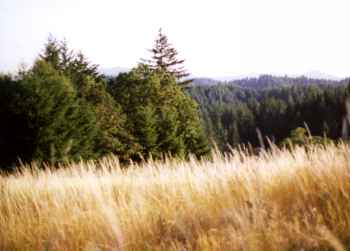

These pictures show the grasses and other plants that are used as fiber in making the cob. The picture of the field is rather deceptive in that it just appears to be grass, but a closer examination shows there are a wide variety of plants, pretty much all of them end up in the mix, though I generally try to avoid using the ferns because of their rather low tensile strength. Avoiding the inclusion of blackberry vines and other thorned plants is also important when doing barefoot cob mixing (ouch!). - Rock - Rocks were dug up from above the site to build the foundation.
- Wood - Logs and branches for the roof structure are all from trees that were blown down or found in slash piles.
- Glass jars - I don't have time to try making glass right now, so I am using glass jars for windows. Jars can be acquired for free from friends, relatives, and waste disposal sites.
- Water - I am using water from a well on an adjoining property, Other sources available include a stream running through the property, digging a well, channeling runoff water into a small pond, or mixing cob while it is raining - the last approach can work quite well, but if you work to slowly or it rains to hard, you will end up with to much water in the mix.
Tools
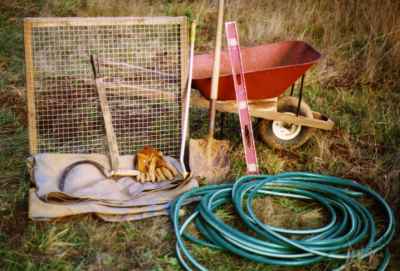
The tools actually used in the construction of the building so far (all of which are shown in the picture above) are as follows:
- Machette- This is my most important tool, and unfortunately the hardest to make a substitute for from materials on hand. The only options I can think of are to fashion a stone blade, or do without. The difficulties involved in not having a cutting tool would give me a real incentive to learn how to make stone knives. The machette is used for:
- Cutting grass to a reasonable length for making cob - alternative: tear the grass into smaller pieces with bare hands, or only harvest shorter grasses.
- Cleaning the ends of grass for thatching - alternative: leave the ends rough.
- Cutting wood for the roof structure - alternative: break small stuff with hands and feet, use a fire to burn through larger logs.
- Trimming the cob - alternative: be more careful about applying the cob, so no trimming is necessary, or let the cob dry until hard, then chip away excess with a rock.
- Sickle - used to cut grass for the cob mix and thatching. Grass can also be harvested by just pulling it out of the ground instead.
- Shovel - used to dig out/level the building site, dig the foundation trench, move the soil into the cob pit, and dig up rock for the foundation. A strong stick or pointed rock works well for breaking up the soil, and a flat rock or bare hands can be used to move the soil around. Interestingly, when digging up rocks that are packed together, a strong sharp stick actually works far better than a shovel.
- Wheelbarrow - used for transporting rock to the building site. Large rocks could be either carried or rolled to the building site, and small rocks could be carried in a twig basket or bare hands.
- 3/4 inch steel screen on wood frame - Used to quickly separate rocks larger than 3/4 inch from smaller rocks and soil. You could just pick the rock out by hand.
- Level - used to keep walls vertical. A plumb bob could be fashioned with grass-twine and a stick or rock to use in it's place.
- Tarp - used for mixing the cob. The cob mixing is done in a shallow pit with a tarp which makes it easier, but traditional cob just used the pit.
- Gloves - protects hands, but are not a necessity.
- Hose - brings water to the site. I could probably fashion a bucket from local materials, but it is simpler in this area to just make cob while it is raining, and/or dig a small pit next to the cob pit to channel rain water into.
The Design
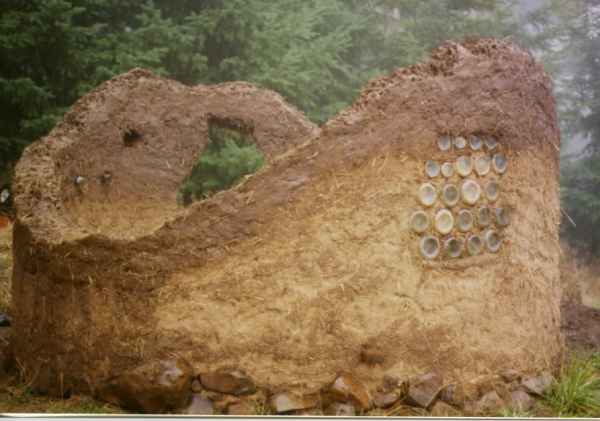
The building is designed to meet the requirements of both the "accessory building" code definition, and the limitations of the materials used. Key design decisions for the building:
- Walls - It is a round building which is structurally the most stable (important because I am using thin walls due to size constraints), and requires the least wall construction for the amount of enclosed space.
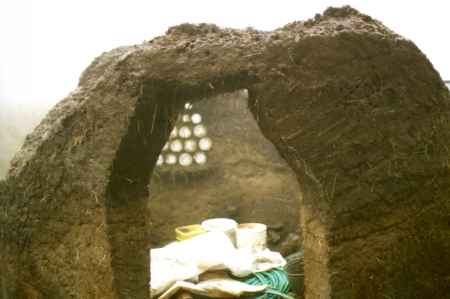
- Windows - The main window faces Southwest for the best lighting on this site. It was created by setting rows of glass jars in a cob matrix. Additional small windows are scattered around the wall using individual glass jars.
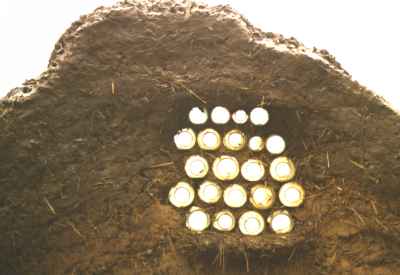
- Door - The door faces Northeast, since that direction is the most protected from wind and weather. This will be important, since it may be difficult to block air flow around any door I can make within the rules outlined above. The cob for the doorway has been given a bevel to make it easier to get a reasonably tight fitting door. The door has not been built yet, but some possible options for the door construction include: a woven grass mat, woven twigs with a thin mud plaster, or a light clay panel.
- Roof - The roof will have a 45 degree slope and be thatched using local grasses.
- Foundation - The building foundation is done "rubble trench" style, and consists of a trench dug down below the frost line (about 1-1/2 feet below the interior floor height), lined with rock to channel water in the bottom away from the building, then filled with coarse gravel. The stem wall is made of large rocks mortared with mud.
But it's not a house!
While this building is not intended to be a house, there is nothing about it that would preclude such a use. Though the interior is only about 80 square feet, this is more than enough space for a bed for two people, a place to hang clothes, a tiny wood stove, an area to prepare food, and a small sink. All of these could be made from cob, wood, and/or fired clay. Aside from an outdoor composting toilet, this is all you need -- anything more is a function of choices you make. (Laundry and bathing facilities have not been overlooked, they are not necessary. It is quite feasible to do laundry in a sink, and to bathe yourself using a wash cloth and sink.) It is important to remember that many homeless people get by with far less.
Some lessons learned (or re-learned)
When the building is complete, this article will be updated, but in the mean time there are a few lessons that I have learned.
- If I could only have one tool, the machette would be my first choice, with a hose or bucket to haul the water running a close second, since these are the most difficult to manufacture or do without.
- It is possible to have grass/straw that is to long for cob. In the past, my cob work has used straw from bales, which (so far) has never been to long to use, so I haven't given much thought to the length of the grass/straw. I may have already known this, but I had to (re)learn it with my first batch. I put the harvested grass directly into the cob on my first batch, it's average length was probably around two feet (with many stalks over three feet long), and having it so long made it virtually impossible to break the batch up into the "cobs" for placing onto the wall once I was done mixing. I was ultimately forced to use the machette to hack managable pieces out of the batch. After this experience, I used the machette to cut the grass into pieces about six to twelve inches in length for all future batches.
- My high clay/silt cob mix once dry will soften much more quickly than an "ideal" cob mix when soaked in water (a few hours as opposed to days), which shows how much of a difference a good high sand mix makes for water resistance.
- When using glass jars for a window, first clean the jars, then put a lid on them, and don't remove the lid until you are done with the building. It is virtually impossible to avoid getting mud inside the glass jars when handling them while building a window, so I now have to clean the insides of all the jars built into my windows, which will be alot more difficult than cleaning them in a sink. You may have noticed from the pictures that the bottoms of the jars are covered in dirt -- it's all on the inside!
For information on related topics:
- Life Statement - articles on small houses, lifestyle, saving money and more, written by the author of this article.
- Cob Cottage Company - the people who are primarily responsible for the revival of cob as a building material world wide. If nothing else you will find much nicer looking examples of cob as a building material.
 Debian Linux