
The Composting Toilet - an ecologically responsible solution
The following article is posted with the permission of the author. You are welcome to link to this page, or make copies of it for personal use, however, the author has requested that you not mirror this article on other web sites.
Thank you for your cooperation.


The Composting Toilet - an ecologically responsible solution
by Flemming Abrahamsson, "Mikroben" nr. 7, 1994 translated from the Danish by "Renewable Energy"
The composting toilet solves with one blow the problems of "black waste water" and loaded nutrient salts in the recipient and overuse of our precious water resources.
- Water consumption
Our daily consumption of water is 180-200 litres which translates to approximately 70,000 litres of drinking water/person/year. Ordinary flush toilets are responsible for 15-20,000 litres of this amount. Composting toilets do away with this water wastage and at the same time keep feces, paper and even urine out of the sewage system.
- The composting toilet
When one mentions the word "composting toilet" or "mulch latrine", people immediately protest and come up with such comments as, "you don't mean you expect us to go back to the use of stinky latrines ?!" and "doesn't it smell like slurry ?!" But on this matter I must be firm - today we have an odourless and comfortable solution very suitable for installation inside the home. In contrast to many so-called "ingenious" solutions such as incineration toilets, freezer-bag toilets, dry toilets and the like, which often require the use of large amounts of energy, a genuine composting toilet consists of a large container in which a composting process takes place before the contents are removed, and a toilet stool + seat very similar in appearance to that of an ordinary flush toilet. The end product of the composting toilet is an odourless humus material totally unlike manure or the contents of a latrine. (there is no danger in handling it and it can be used as fertilizer for shrubs and decorative plants as long as it has had soil contact for 19 months)
- Denmark's neighboring countries
During the past few decades, individuals in Norway and Sweden have been continuously working on the development of composting toilets, so that today we have a new generation of composting toilets. In 1982, according to the Nordic Ministercounsil, there were 300,000 composting toilets installed throughout Scandinavia. I suppose that Denmark accounts for only about 100 of these. Development has continued at a fast rate in the neighbouring countries and the latest encouraging news is that Tannum "municipality", near Goteborg, Sweden, has recently forbidden flush toilets from the year 2000 and currently builds 70% of their new housing without flush toilets.
- Development in Denmark
Because of the fact that 7% of Danish housing (in rural areas) aren't connected to central sewage systems, some research on composting toilets has been undertaken at The Danish Technical University and the most current news in this field is that a project called "Kompost-toiletter 1994" by Simon Wris-Berg and Peter Friis Moller has been awarded a prize by Denmark's agricultural school. Some Danish firms have experienced an increase in inquiries about composting toilets during the past few years due both to increasing environmental awareness as well as ever increasing water costs.
- The design of a composting toilet
Composting toilets vary in appearance depending upon the manufacturer, but common for them all, is that they have a collection container for feces, paper, in some cases kitchen garbage, while some separate urine into a second container. The contents of the feces container are composted by aerobic process, which takes about one year, into a humus like material. In the company "Renewable Energy", we have developed a year-round model called the "Eco-composter" for family homes. The collection container of our toilets is made of fibre reinforced concrete which makes for a reduction in use of fibreglass and epoxy. The toilet stool, which is made of either fibre-concrete or porcelain, is designed so that urine and feces are kept separate. The feces, paper and kitchen garbage drop vertically down into one tank, while the urine is collected at the front - a design appropriate for both female and male use. In this way the urine can, without coming into contact with the feces, be collected in a tank and because there is no danger of disease, be used as liquid fertilizer when mixed with 4-5 times its amount in water. The urine can also, of course, be mixed with household "grey waste water". But this must be regarded as the second solution. Our porcelain stool is designed in such a way that the urine compartment can be flushed with 0.1 litres of water. The tank has ventilation channels to enable the oxidizing process to take place, and all air is drawn up through a vent which reaches up through and over the roof of the house. This means that the composting toilet itself functions as a ventilation system for the entire toiletroom, keeping out unwanted smell. This makes for quite an advantage - there is never any unpleasant smell connected with a "visit" to the toiletroom.
As indicated in table 1, a family's yearly production of compost humus is approximately 100-200 litres (the original amount of uncomposted feces having been greatly reduced after composting).
Table 1 Yearly production per adult human:

400-500 litres urine which contains:

   5   kg nitrogen
   0.4 kg phosphate
   0.9 kg potassium

50-60 litres feces which contains:

   0.1 kg nitrogen
   0.2 kg phosphate
   0.2 kg potassium
Table 2

substance  unit  sewage sludge  human manure  animal manure  soil
---------  ----  -------------  ------------  -------------  -----
N          kg/t         30          250             25       1-2
P          kg/t         20           35             10         0.4
K          kg/t          2           45             17         0.5
Ca         kg/t         25           30             12        25
Mg         kg/t          4            7              4         7
Zn         g/t        1750          200           100-800     26
Cu         g/t         250           30            20-350      8
Ni         g/t          20            2             1-36       5
Cd         g/t           7            0.4            0.3       0.2
Pb         g/t         300            1             5-15      17
Hg         g/t           5            0.5                      0.05
____________________________________________________________________________

table 2: The amounts of nutrients & heavy metals in manure and soil
source: J.Aa. Hansen and J.C. Tjell, 1982 w/Jacob Vester
____________________________________________________________________________
The components of our composting toilet take up the same amount of space as a traditional flush toilet in the toiletroom itself, while the collection-container and ante-chamber are located beneath the floor of the toiletroom or from a connected "lightbox" located outdoors.
- Infection and the authorities
The Danish authorities require that the same minimum criteria are fullfilled as with sludge delivery, due to a risk of disease-carrying bacteria and parasites, although the compost can always be spread on the ground because the amount of heavy metals in human feces + urine is extremely low when not mixed with other wastewater (see table 1) The compost-humus could of course be pasteurized at 70 degrees for a minimum of 1 hour, but this holds no interest for us, because we want to avoid the use of large amounts of energy and retain the good balance with nutrients which are present in the compost-humus. We don't want to use energy for no reasons. We require that the compost is brought in contact with soil bacteria and kept behind a little fence for yet another year before being spread out on gardens or fields. This requirement is easy to live with in cases where here is a complete plan for the composting toilet and the "grey wastewater", for instance first via a microbiological cleaning in a sandfilter and finally by means of gravitation in an "energy-forest draining system" so that we really can put the compost in the "energy-forest". Today we are no longer confronted with the same resistance to this installation design as 10 years ago, due to greater environmental awareness and stricter wastewater treatment requirements.
- The future
We will experience fast and hopefully creative development in the area of composting toilets combined with more research which initially can find support in the results of our neighbouring countries. Because the lack of fresh water is a global problem, these solutions are quite suitable for export to other countries.
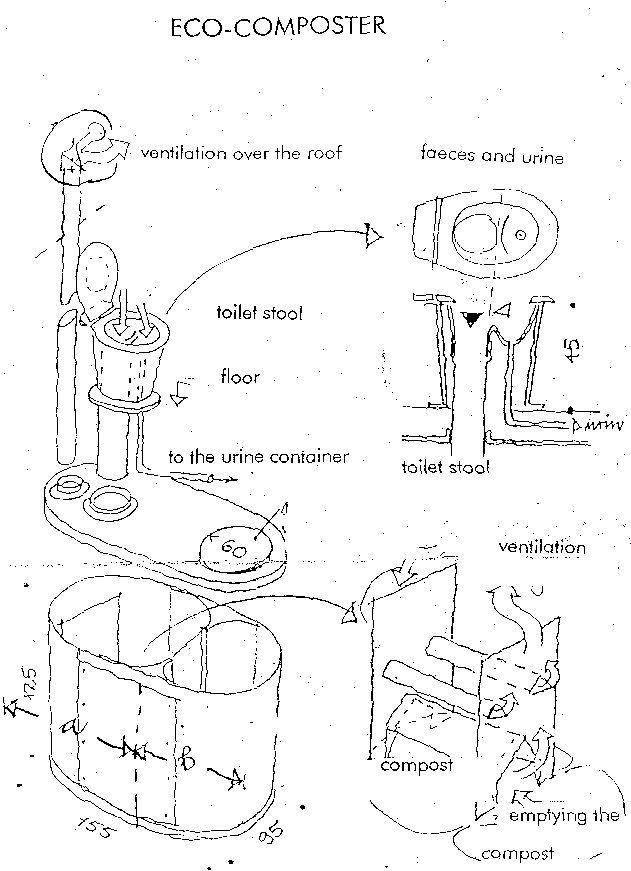
Price: around 12000 d.kr. incl. toilet stool, compost container and ventilation
 Debian Linux